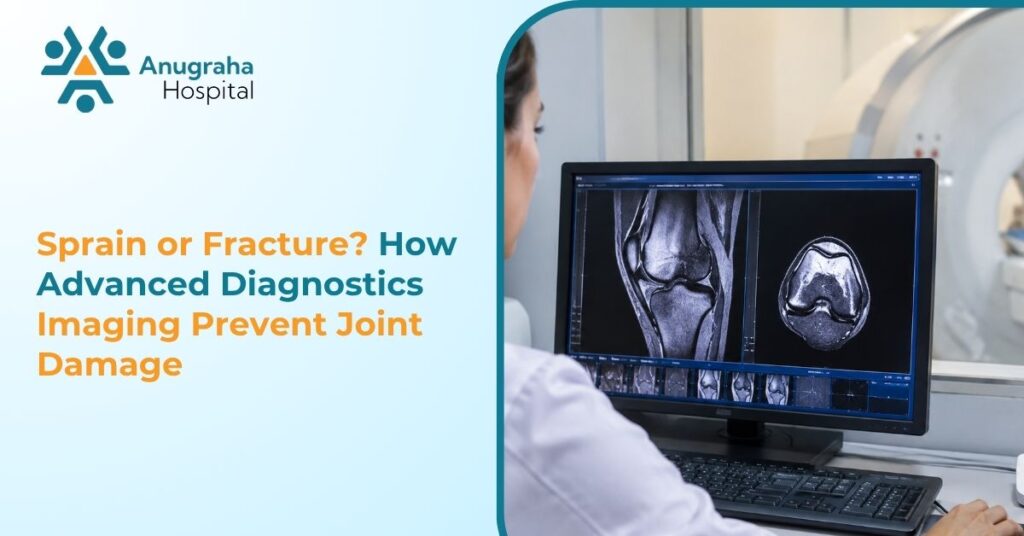
You fall, twist your ankle, and it swells almost immediately. Is it a sprain, or is there a fracture underneath?
Pain, bruising, and swelling can occur with both. Looking at the joint doesn’t always tell you what happened inside. Trying to walk it off or waiting until morning can delay assessment when an injury needs treatment sooner.
That is where the advanced diagnostics imaging in Chennai can make a practical difference. Prompt assessment and appropriate imaging can identify fractures, dislocations and other injuries without leaving you guessing through the night.
Table of Contents
|
Sprain vs. Fracture: Why You Can’t Tell From the Outside
Soft Tissue vs. Bone
A sprain occurs when a ligament, the tissue that helps stabilise a joint, is stretched or torn. A fracture is a crack or break in a bone.
The same fall can cause either injury or both. A hard landing can fracture a bone while also damaging surrounding ligaments. A simple twist can produce a significant ligament injury without breaking the bone.
When Symptoms Don’t Tell the Full Story
Swelling isn’t a reliable severity meter. Some fractures cause considerable swelling, while smaller or hairline fractures may initially produce manageable pain.
The opposite can happen with sprains. A badly injured ligament can become extremely painful and swollen even when the bone is intact.
A physical examination helps a doctor assess the injury, but imaging may be needed to confirm what has happened. X-rays can identify many fractures, while MRI or CT may be appropriate when more detailed information is needed.
How Unseen Damage Can Worsen Your Condition
When an Injury Heals the Wrong Way
A fracture needs appropriate alignment and treatment to heal properly. Nonunion means a broken bone fails to heal, while malunion means it heals in an incorrect position.
That distinction is important around weight-bearing joints. A bone that heals out of alignment can affect movement, stability and how forces travel through the joint.
Early imaging doesn’t guarantee a complication-free recovery. It gives the treating doctor better information about the injury and helps determine appropriate management.
What Can Happen Over Time
Some untreated ligament injuries can leave a joint unstable. That instability may contribute to recurring injuries, persistent pain or restricted movement.
Serious joint injuries can also contribute to post-traumatic arthritis, which is joint degeneration that develops after an injury.
Severe Trauma creates another concern. Nerve or blood-vessel damage can accompany certain fractures or dislocations. Numbness, unusual skin colour or a cold limb should never be dismissed as ordinary swelling.
How Advanced Diagnostics Imaging Protects Your Joints
Zero Delay When Timing is Important
An injury doesn’t follow clinic hours. It can happen at 2 AM, during a weekend, or on a public holiday. Access to advanced diagnostic imaging means suitable patients may be assessed and investigated outside routine appointment hours and get MRI, CT, PET, or ultrasound.
That can reduce the wait between injury, medical assessment and imaging. More importantly, it gives doctors information sooner, when the result could change what happens next.
This doesn’t mean every injury belongs at India’s most trusted diagnostic centre. Severe trauma requires emergency medical care, and imaging should be part of the clinical assessment rather than a substitute for it.
From Scan to Treatment
Imaging helps show what the doctor is dealing with. Depending on the findings, treatment may involve immobilisation, a cast or brace, reduction to restore a displaced joint or fracture to its appropriate position, or further orthopaedic care.
The scan doesn’t make the decision of going to the best diagnostic centre on its own. The doctor considers the advanced diagnostics imaging alongside your symptoms, examination findings, medical history and the type of injury. For suitable cases, a streamlined imaging route can simply remove an unnecessary diagnostic step.
Quick Guide: X-Ray vs. MRI vs. CT Scan for Joint Trauma
X-Ray: The First Check for Many Fractures
X-rays are quick and commonly used after trauma. They can identify many fractures, dislocations and other obvious bone injuries. For a suspected broken ankle, wrist or other joint, an X-ray is often an initial investigation.
MRI: Looking Beyond the Bone
MRI provides detailed images of soft tissues such as ligaments and tendons. It can help assess injuries that aren’t clearly visible on an X-ray.
It isn’t automatically required after every sprain. A doctor may recommend it when the clinical picture calls for a more detailed assessment.
CT: A Closer Look at Complex Fractures
CT creates detailed cross-sectional images, making it particularly useful for complex fractures and areas where precise bone detail is important.
The most advanced scan isn’t necessarily the best scan. The appropriate test depends on the suspected injury and what information the treating doctor needs.
Warning Signs That You Need an Urgent Scan Right Away
Some injuries deserve immediate medical attention:
- Cannot bear weight: You cannot stand or use the injured limb normally.
- Visible deformity: The joint or limb looks bent, displaced or abnormally positioned.
- Numbness or tingling: Particularly below the injured area.
- Cold, pale or blue skin: This can signal a circulation problem.
- Severe or worsening pain: Especially when it persists despite rest and basic first aid.
- Rapidly increasing swelling: Particularly after significant trauma.
If there is severe deformity, an open fracture, loss of sensation, or signs of poor circulation, seek emergency medical care immediately. Don’t simply arrange a scan and wait.
Concluding Words
You cannot reliably tell a fracture from a serious ligament injury by looking at a swollen joint. The symptoms overlap too much.
Waiting can delay treatment when the injury needs prompt attention. A medical assessment followed by appropriate imaging can provide the information needed to decide what happens next.
If you or a loved one has suffered a joint injury, don’t wait. Visit Anugraha Hospital’s 24 hour emergency and diagnostic centre for rapid, accurate imaging and expert orthopaedic care. Contact the emergency desk or walk in today.
FAQs
Can a sprain look worse than a fracture?
Yes. Severe swelling and bruising can occur with significant sprains, while some fractures initially cause relatively manageable symptoms. Appearance alone cannot confirm the injury.
Can an X-ray miss a fracture?
Yes. Some subtle fractures may not be clearly visible on an initial X-ray. Further clinical assessment or advanced diagnostics imaging may be needed if symptoms continue or suspicion remains high.
When should I get a scan after a joint injury?
Seek prompt assessment for severe pain, inability to bear weight, deformity, numbness, circulation changes or significant trauma. Severe deformity, open fractures and circulation problems require emergency care.